
A grid battery built to replace lithium-ion.
 Backed by
 4 patents filedMade in the USA
Qnetic's roadmap targets 3,500 deployments a year by 2030.
The final investor webinar · Friday, October 2 · 2:00 PM ET / 11:00 AM PT
Your last chance to question the founders before the round closes
Michael, Loïc, Hugh and Malcolm take investor questions live on Zoom. It’s the last session of this round, so bring the hard ones.

Michael Pratt
Co-founder / CEO

Loïc Bastard
Co-founder / CTO

Hugh McDermott
CCO, President Americas

Malcolm Mathews
COO
Watch Qnetic in action
The prototype
Meet Vega, already built and spinning
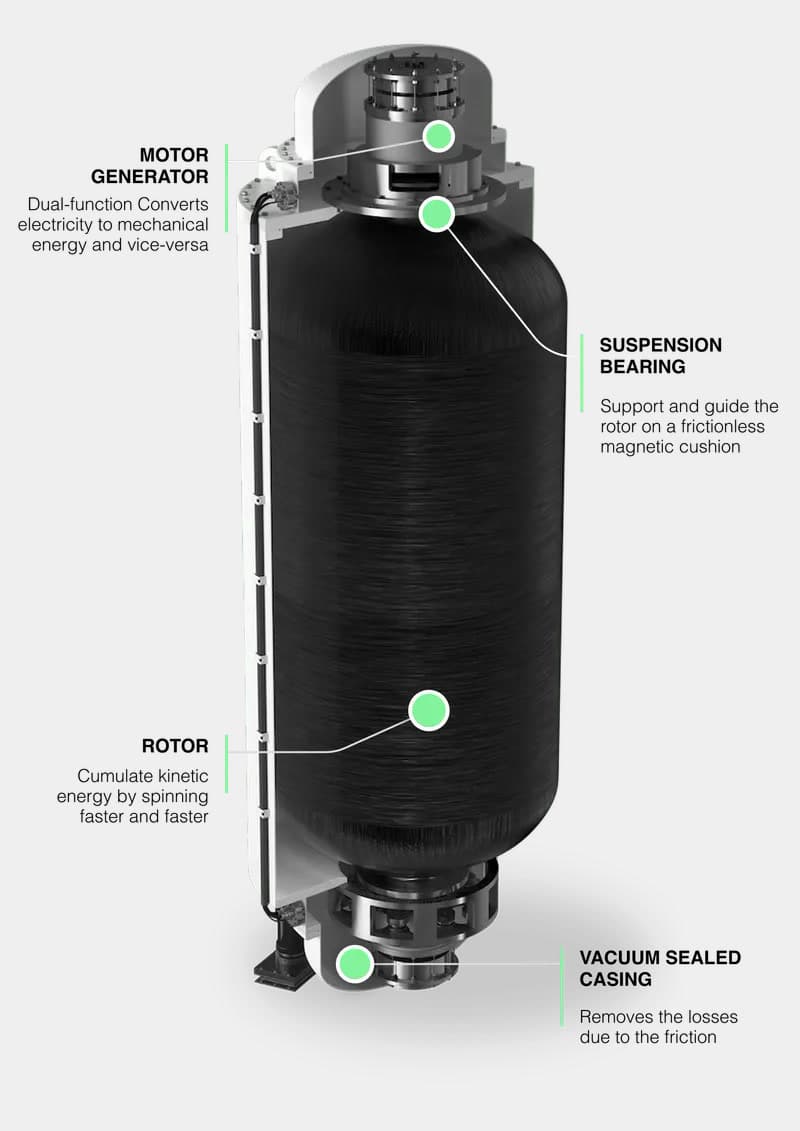
Vega is Qnetic's fully functional lab-scale prototype. It runs today, and it proves the core technology the full-size system is built on: a high-speed rotor spinning inside a vacuum, held steady on friction-free magnetic bearings.
How It Works
How the Qnetic battery works
- 1
Charge
A motor spins a rotor, turning electricity into kinetic energy. The faster it spins, the more it stores.
- 2
Store
The rotor keeps spinning in a vacuum-sealed chamber on magnetic bearings, near-frictionless, with zero chemical degradation.
- 3
Discharge
The motor switches to generator mode, slowing the rotor and converting its kinetic energy back into electricity on demand.
Qnetic Mechanical Battery
1 MWh
Capacity
250kW
Power
4-12 hrs
Discharge
>85%
Round-Trip Efficiency
The flywheel question
“Aren't flywheels just for short bursts of power?”
Traditionally, flywheels were built for for minutes or even seconds of discharge power, not high storage capacity. Qnetic is engineered for the opposite: long-duration energy storage, using a high-speed rotor in a vacuum on magnetic bearings.
- 4 to 12 hrsDischarge duration, not seconds. Already shown in testing.
- 1 MWhPer unit. One to two orders of magnitude larger than typical 10 to 100 kWh flywheels.
- 0.5% / hrTarget self-discharge, from the vacuum chamber and friction-free magnetic bearings.
Problem
The World is Running Short on Reliable Power
From AI data centers to hospitals and beyond, the world needs uninterrupted power. But its current backbone, lithium-ion batteries, degrades from day one, spontaneously combusts, and depends on supply chains controlled by China. It's why the IEA flagged lithium supply chains as a systemic risk to energy security. The grid needs a long-lasting alternative that sidesteps those risks.

$3T1
Global energy storage market projected to exceed.
$70B+2
invested in climate tech in 2022 alone.
90%3
Renewables will account for 90% of new power capacity (IEA).
The world needs reliable storage systems that can store energy when production is high and release it when it’s low. Like ours.
Why now
The World is Running Short on Reliable Power
Power demand is growing faster than the grid can supply it. Electrification, EVs, and AI are pulling more and more load from the grid. Matching this with variable generation from renewables has never been more demanding on grid energy storage. Our tech is built for making sure you're not left in the dark.
~945 TWh4
Projected data-center electricity demand by 2030, roughly double 2024 (IEA).
~50%4
Of all U.S. electricity-demand growth this decade comes from data centers (IEA).
15×5
Forecast growth in global energy-storage capacity by 2030 (BloombergNEF).
Who needs it most
AI data centers
Racks that run around the clock cannot tolerate an outage, or a lithium fire next to the servers. This is the fastest-growing load on the grid.
Utilities & power producers
Daily cycling to shift solar and wind into the evening peak. Qnetic's 800-unit commitment comes from a major independent power producer.
Hospitals & critical facilities
Sites where a blackout is not an inconvenience but a danger, and backup has to last hours, not seconds.
Public power authorities
Municipal and regional grids modernizing aging infrastructure. Qnetic's roadmap targets more than 80 of them by 2029.
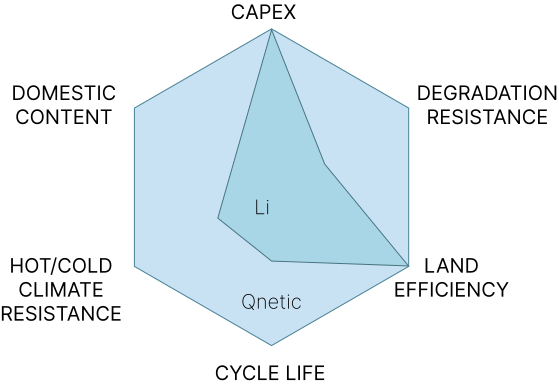
Qnetic vs. Lithium-ion
Outperforming across the board
Qnetic
Lithium-ion
Lifespan
Designed for 30 years with no capacity fade
Degrades from day one
Cycles per day
As many as needed
1, to preserve lifespan
Fire risk
None
Spontaneous combustion risk
Supply chain
US-assembled; no lithium or cobalt
China-controlled
Lifetime cost
Projected ~2× lower per MWh (company estimate)
Higher projected lifetime cost
Climate range
Designed for desert heat to Arctic cold
Low efficiency in cold or hot weather
The full offering is on DealMaker.
Real demand, already signed
Operators are lining up, including major independent power producers.
$150M
in signed LOIs
9
customers who have signed
1,000+
units indicated across the LOIs
LOIs are non-binding and there is no guarantee they convert into binding orders.
Backed by
Conviction from the people who fund climate tech
The funds and operators who underwrite the energy transition put their own capital into Qnetic.

SOSV
Lead institutional backerThe world's #1 most active climate tech investor, via its HAX hard-tech accelerator. SOSV led Qnetic's seed round.

The team delivered on its promises, building its prototype and securing $100M in LOIs from eight customers across three countries, proving its exceptional execution.
Léa Bouhelier-Gautreau
Senior Investment Associate, Kingscrowd Capital· from Kingscrowd’s Investment Roundtable
Pilot Projects
Two Pilots, four validators, over 10 participating utilities and hyperscalers
Pilot-scale deployments in 2027, independently validated by EPRI and the National Lab of the Rockies.
Pilot 01
SMUD
Q1 2027
Sacramento Municipal Utility District. Two beta units on a live utility grid.
Pilot 02
National Lab of the Rockies
Q2 2027
Hosted at the lab's ARIES campus in Boulder, CO (the lab was formerly NREL), a facility able to replicate virtually any energy-storage use case.
Independent validation & technical partners
In the press
How This Mechanical Battery is Making a Comeback
Qnetic began on a three-month, 6,000 km bicycle trip through sun and rain, hills and plains. The founders set out to answer one question: forty years from now, looking back on our lives, what did we do that made a positive impact on the world?
As engineers, the answer was clear. Rethinking how the world stores energy is one of the most direct ways to take on climate change. That ride became Qnetic.
Our Story: Why We Started Qnetic
Featured on Undecided with Matt Ferrell. How This Mechanical Battery is Making a Comeback
Team
The people building it
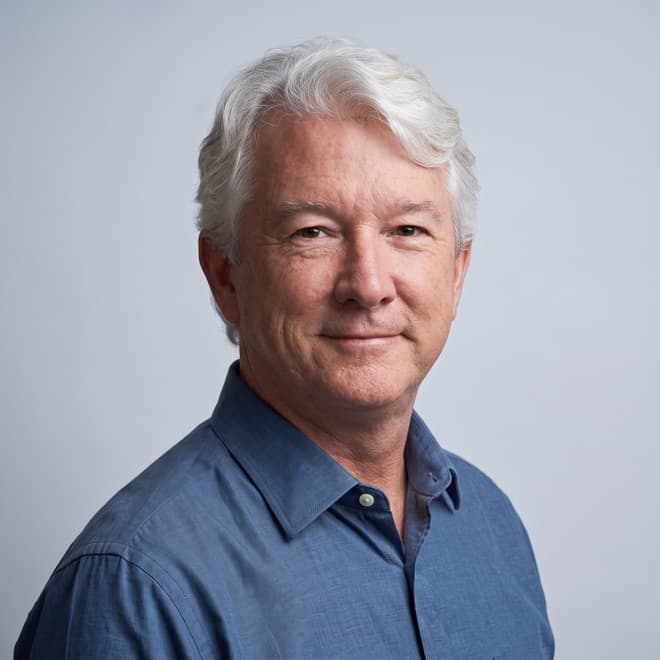
Loic spent ten years at Siemens on rotating machines, and Gene had already put 40 MW of flywheels on the US grid at Beacon Power.
Award-winning product design specialist—16 years' experience in leading product development consultancy IDC in London and Shanghai. Inventor on several patents and has track record of successful, innovative and award-winning products. Was the founding General Manager and Technical Director of the China business for IDC, leading delivery of exceptional results for clients across diverse product types.

Former Head of Department at wind turbine manufacturer Envision Energy and 10-year veteran of Siemens. Expert in designing and analyzing complex rotating systems with 18 years experience across jet engines, gas turbines and wind turbines. Specializes in vibrations, rotor dynamics, and FEA.


Global business executive with 30 years of leadership across industrial, technology, and services sectors, including roles as APAC CFO at Johnson Controls, Stanley Black & Decker, and Carrier. He has overseen multi-billion-dollar portfolios, major restructurings, and growth initiatives across Asia-Pacific.


Started in energy storage in 2009. Spent four years at Better Place raising $250M. Joined ESS in 2017, helping commercialize flow batteries. He's seen the storage market evolve firsthand.


Gene Hunt
Director, Public Relations
Supported getting 40 MW of flywheel energy storage onto the US grid with Beacon Power between 2007 and 2011. Decades of hands-on experience with the exact technology Qnetic is scaling.



Roadmap
The plan: from prototype to 3,500 units a year
Planned milestones as of this writing. These are forward-looking targets, not commitments, and timing may change.
2026
- First serial product prototype build and test
2027
- Customer pilot deployments and validation testing.
- Full-scale U.S. production ramp-up.
2028-2029
- First commercial installations with utilities and energy developers.
- Expansion to 80+ public power authorities and large-scale deployments.
2030
- Run-rate of 3,500+ units deployed annually, international expansion into Europe and Asia.
 The offering
Qnetic is conducting an offering of securities under Section 4(a)(6) of the Securities Act (Regulation Crowdfunding). The offering is conducted through DealMaker Securities LLC, a registered broker-dealer and member of FINRA/SIPC, acting as broker of record.
View the offering and risks on DealMakerQnetic Corp is offering securities under Regulation Crowdfunding (Section 4(a)(6) of the Securities Act) through DealMaker Securities LLC, a registered broker-dealer and member of FINRA/SIPC. The securities are not registered with the SEC and no regulator has approved them or passed on the accuracy of these materials. Investing in early-stage companies is highly speculative and involves risk of total loss; shares are illiquid and resale is restricted for one year. Non-accredited investors are subject to investment limits based on income or net worth. This page contains forward-looking statements (plans, targets, and projections, including design-life and cost estimates and the deployment roadmap) that involve significant risks and uncertainties; actual results may differ materially. Complete offering terms, the Form C, and the Risk Factors are available on the DealMaker offering page. Only invest what you can afford to lose.
Frequently Asked Questions
Regulation CF
Qnetic Corp